Tyla and Coloured identity in the media
When Tyla became a mainstream artist after the release of her hit single “Water” in July 2023 she grabbed media attention swiftly.
Along with the virality of her most successful song came a “revelation” of her identity as a Coloured South African. This was not a shock to anyone from South Africa or any other Southern African country, as we know that this is the term used for multiracial people of Afro-Asian (and Afro-European) descent.
But, in typical American fashion, Americans decided to centre themselves in an issue that does not concern them. Nothing new!
However, what stood out to me about American-centric discourse was not the narrations of how offensive the word colored, small c, is in the United States compared to Coloured, capital C with a u. Rather, it was the false parallel between Coloured ethnicity and the Mulatto class spread by many uninformed Americans and others influenced by their ideology, including from Southern Africa! An added layer to this twisted history were claims that the formation of Coloured identity was similar to the whitening of Black and mixed population in former Portuguese and Spanish colonies such as Brazil.
Definitions
Let’s start with some definitions to unpack why this was particularly absurd and ignorant.
Mulatto (fem mulatta) refers to a mixed race person of Sub-Saharan African ancestry and European ancestry only. The word “only” is very important here, because what is referred to is a person who is only half black and half white. It usually refers to people from the Dominican Republic. The term is considered offensive in USA.
The term Coloured refers to people of mixed ancestry including heritage from Europe, Africa (Southern) and Asia (usually South Asia or Indonesia). This ethnicity is found in former British colonies of Southern Africa, particularly South Africa, but also Zimbabwe, Zambia, Namibia and Botswana.
Looking at these two definitions helps us understand why making a comparison between someone half white and half black and someone multiracial is quite absurd. The fact of being mixed-race does not automatically create a parallel between them, and certainly does not suggest any correlation between their historic actions during slavery, colonialism, and the current neo-colonial period.
The better correlation to make was to the mestizos of the Dominican Republic, as mestizo refers to people who are “tri-racial”, having African, European and Indigenous American (Taino) roots.
However, Americans took to Twitter to accuse Tyla and other Coloured people of celebrating their identity with the intentions of causing the same harm that Mulatto elites caused during the Haitian Revolution.
A False Parallel
The Mulatto class in Dominican Republic who fought against Jean-Jacques Dessalines were quite specifically elites, meaning they were the children of slave owners. This class position explains why they would betray the revolution and propose the idea that Hispaniola be divided into Haiti and the Dominican Republic, as well as attempt to keep slavery alive. There is a class interest any person of any race who is a slave-owner to ensure that this system stays alive and maintains their wealth. A mulatto from a poor background or a mestizo with less connection to white ancestry, would likely fight for self determination and an end to slavery and racial oppression.
Coloured identity initially began when Khoekhoe, San and enslaved Asians from Indonesia started to intermix, creating half African and half Asian children. A person with no white ancestry was regarded as a person of “full colour” by the Dutch colonist, and so this is how these Afro-Asian children would have been seen. It was not relevant to the colonist that they had less Black ancestry, what mattered was that they were still a “savage” of “full colour.” They were still regarded as undesirable and so European children were discouraged from mingling with them to avoid the idea of mixed marriages.
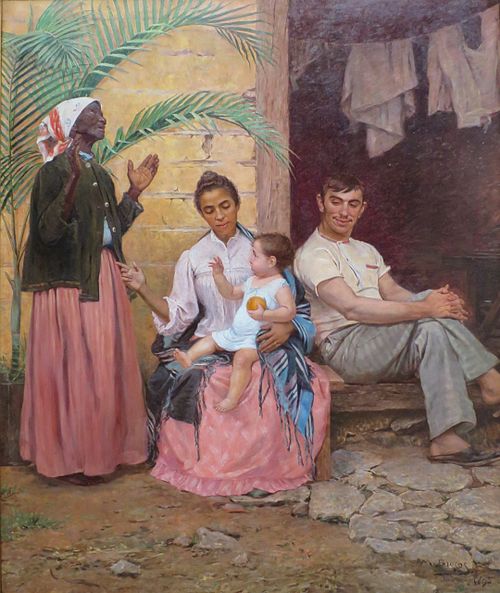
On the other hand, there were some relations between the African population and White slave-owners, often forced. They also occurred with white workers,who later migrated from France and the Netherlands to work in supervisory positions on the Dutch slave owners’ plantations, and African women. These Afro-European (or mulatto) children (usually the girls) were taken away from other mixed race children and encouraged to marry another white person with the aim of whitening the family. This is parallel to what is depicted in the Redemption of Ham (A Redenção de Cam, pictured below), a painting that depicts the encouragement of whitening families (branqueamento) in Brazil. They did not become Coloured children, they became offensively referred to as “quadroons” (half mulatto and half white) and their children would become “octoroons” (half quadroon and half white).
Coloured ethnicity in the Cape Colony
Meanwhile, as more Afro-Asian children were born, a new culture began to form and they began to intermarry, which expanded the early formations of the still small Coloured ethnicity. Transportation of more enslaved Africans from places such as Madagascar and Mauritius, who are also an Afro-Asian population, meant that there were more people to intermarry with and who contributed to the genetic variety of Coloured people. Enslaved people from India, Malaysia, and Sri Lanka were also brought to what was then known as the Cape Colony, who also slowly began to intermarry African and Coloured people.
By the time the British arrived in the 1800s and took over from the Dutch, the Coloured population was substantial, and expanded through British relations with the Xhosa people in the Eastern Cape. Indentured labourers from St Helena and China would also have been integrated into Coloured communities.
Coloured Identity in Zimbabwe and the rest of Southern Africa
Migration out of South Africa during various wars that took place in the 1800s meant that a small group of Coloured people would settle in Zimbabwe or travel further north to Zambia or Botswana. Coloured identity was also formed in Namibia.
British colonisation of Zimbabwe (then known as Southern Rhodesia) meant that there were relations between the African women mostly and British men who produced mixed race children. To a smaller extent, British women would have relations with African men. There were varying results of such relations depending on whether the British mother or father claimed the child or not. Many children who were not claimed by their white parents ended up in orphanages, while other remained with the African side of their family. Mixed race children were put in schools together and when tighter segregation laws were introduced, they would marry one another, as well as other Coloured people hailing from South Africa.
Similar social relations could be observed in the much smaller Coloured community in Zambia, then known as Northern Rhodesia. Due to migration, Coloured families in one country have relatives in another, so it is not uncommon for a Coloured person in Zimbabwe to have relatives in Botswana, for example.
The history of the term Coloured
The term Coloured was being used as early as the 1800s, and is not an apartheid term. While the term became complicated by apartheid, as well as segregation and racial classification in Rhodesia, this remains a term that Coloured people claimed for themselves in a time when much worse and far more degrading racial terms were used to describe them.
While it is indeed connected to colonial history, it is NOT an apartheid term. It is an identity that began to take root during the slavery epoque which endured the British colonial era, apartheid rule/segregation, and continues to develop in the neo-colonial period. It is a story of people making a new identity in a time when people of “full colour” have not been allowed to do so, regardless of their race.
The choice to fight alongside apartheid SA was usually along class lines, but there are many Coloured people like Ashley Kriel who fought against apartheid. Many male Coloured soldiers were often forcibly conscripted to fight alongside Rhodesian forces, but there were many who were against the racialism that the colonial government promoted.
Decentring American Interpretation
It is unwise to take American ideology and apply to something that happened thousands of kilometres away. Particularly when these applications of ideology and history are wildly inaccurate and not rooted in the history of Southern Africa, but in America. The United States is NOT the centre of our world. South Africa is the centre of the world to a South African, Zimbabwe to a Zimbabwean, and so on. Why should we centre our history and identity on a country so detached from our reality?
This is not to say we should not acknowledge their struggle and their own narratives concerning words such as colored and mulatto. It is rather to say that their narrative is not the only one.
It is dangerous to allow cultural imperialism to erase the development of other ethnicities and identities, who can contend with themselves on whether their labels are offensive, and what words to use to be more politically correct, if that is the path they choose.
As mentioned earlier, mestizo identity is more related to Coloured identity, and in fact, mestiço is used to identify multiracial people in former Portuguese colonies such as Angola, Cabo Verde, Moçambique and São Tomé and Príncipe. Coloured Zimbabweans living in the east of Zimbabwe in places such as Mutare, which boarders Moçambique, have had relations with mestiço people from their and easily relate despite linguistic differences.
To relate these identities to mulatto identity is to erase the actual relations that take place in Southern Africa. It is also unfair to relate biracial peoples’ identity to multi-mixed race populations, as the experiences are simply not the same. A person living with parents of different races is, quite obviously, not the same as a person who has two mixed race parents, and especially not the same as a person with four mixed grandparents.
Conclusion
Bearing in this in mind, I would like to suggest we be more careful in the way we speak about identities outside America, where concepts such as the one-drop rule are not used. It is important to allowed mixed race ethnicities to self determine. Imposing narratives on them, ironically, interrupts expressions of their Africa, Asian or Indigenous roots by expecting them to express only one side of themselves.
This is especially true for Southern Africans ourselves. Let us not betray ourselves by losing our own narrative and parroting what Americans have to say.
The formation of creolised cultures is a wonderous display of resistance and defiance towards a colonial system that showed a vicious hatred for mixing and cultural diversity. That people could manage to amalgamate cultures that the colonists were so eager to erase, and persisted in maintaining and growing these cultures, should be looked at in admiration and awe, not with scorn. Colonists have always desired for mixed race children to be discarded, but they insisted on being seen and on existing freely.
This is a colourful history. We do a disservice by absorbing it into a history where it does not belong. Let us do the work of digging up more of our history in Southern Africa and telling it loudly and proudly, never crumbling to the pressure for it to fit in anyone else’s narrative.
This is our region and our fight against colonial and neo-colonial history. This is our journey to self determination. We must not allow ourselves to be told what route to take towards sovereignty. And neither should we allow ourselves to be prescribed any remedies for our own issues such as self hatred and discrimination, particularly as we have already started remedying these issues ourselves.
The world is too large for a single story. There is space enough for all of us to be proud of or struggle to identify ourselves.
Let us move into the future in a more enlightened fashion, seeking to support the autonomy of others rather than to impose on it.
Imposition is the imperialist’s way of thinking. Dare to think another way.
 Sasha's Space
One thought on “Coloured People are NOT Mulattos”