David Kolb’s is the educational theorist who developed the Experiential Learning Theory in the 1970s. It is divided into two parts, the first being Kolb’s Learning Cycle and the second being Kolb’s Learning Styles.

Kolb’s Learning Cycle:
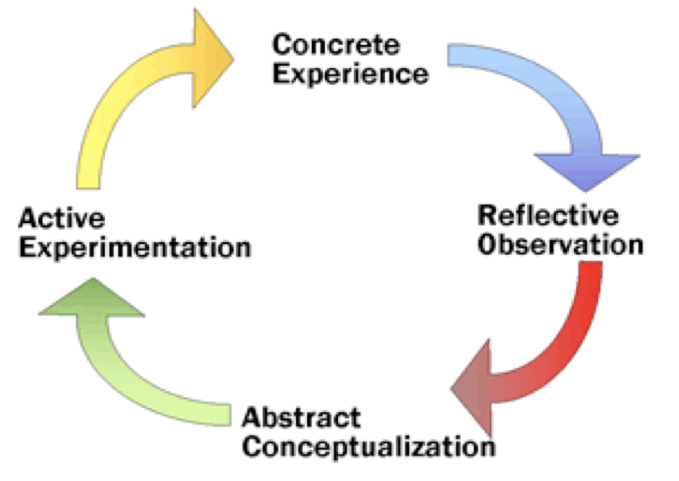
Kolb theorised that in order to learn something, an individual had to experience it, reflect or think about it, draw a conclusion and go on to experiment with what they have learnt. These four steps have to follow each other but not always in the order listed. One could start with Abstract Conceptualisation rather than with Concrete Experience, for instance.
Kolb’s Learning Styles:
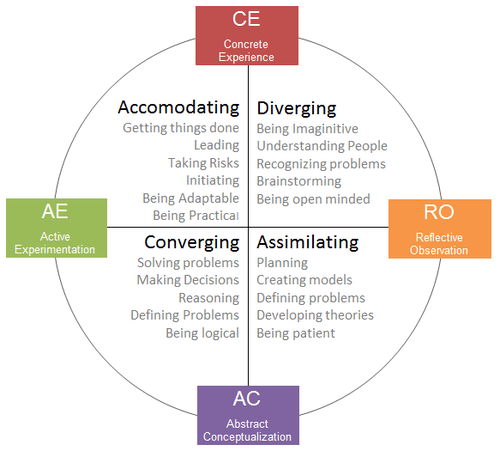
Kolb also theorised that an individual may experience some parts of the cycle more strongly than other and combinations of the strongest two can influence their learning style. Learners are divided into four groups: Activists, Reflectors, Theorists and Pragmatists. Activists are people who prefer to have a concrete experience of something and then experiment with it. Such individuals are proactive, hence, they are great leaders and take risks. A person could prefer to have concrete experience of something and then reflect on it. Such learners are good at understanding people and recognizing problems. They are able to work in teams and are very useful brainstorming partners. These learners are Reflectors. Theorists prefer to assimilate information. They reflect on a topic, concept or experience and form a conclusion about. They are more scientific and like to plan and create models, hence they are quite patient people as these things take time. Pragmatists are in love with logical, so they solve problems and make decisions. They look for reasoning in everything in order to define problems before solving them.
My learning experience has shown me that I am a Reflector as I prefer to ponder what I have experienced and figure out why things are that way. I have a great interest in people’s culture hence I feel I am able to understand them better as I realise how their cultural experiences form their identity and personality. I enjoy writing from time to time and naturally, creating a captivating poem or intriguing prose requires imagination. Depending on the topic, I am fairly good at brainstorming and recognising problems.
I recognised these skills during the Thursday lectures as these are the things I begin to do naturally. The lectures cover a variety of topics and often highlight the problems with the specific issues discussed for each topic. For example, the issue of gender inequality was apparent to me during the art lecture.
Although I do enjoy the Thursday lectures, not all of them have been easy for me to cope with. Sometimes the information is too difficult to digest or the vocabulary is inaccessible as I have never heard some of the terms before. Hence, I struggle to take notes of points I am aware are important as I cannot summarise them effectively and in a way I can understand fully. I am surprised, however at the generation of ideas I am experiencing lately. I am very interested in issues of gender and race and I have begun to think of them in different ways no, possibly because of my exposure to a new environment. Although I may not understand all of the topics lectured on, I do understand my weaknesses in note taking and intend to improve on it in good time in preparation for my undergraduate course.
 Sasha's Space